





Pool Copings in Natural Stone and Porcelain
Pool copings are the top edge of the pool structure, finishing the shell and forming the interface with the surrounding terraces, decks and landscaping. This page brings together information on our natural stone copings, porcelain copings and the dedicated corner units that complete the perimeter. Each coping system is designed to work with a defined set of thicknesses, edge profiles and surface finishes, and to coordinate with matching paving or porcelain tiles. Stoneworld provides options suited to family pools, hotel and spa environments and design‑led private projects, all supported by digital templating and precise workshop fabrication.


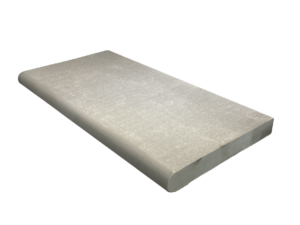


Natural Stone Pool Copings
Natural stone pool copings are the choice when you want the pool to feel rooted in the wider landscape. Limestones, sandstones and other selected stones bring natural variation, subtle texture and a sense of permanence that works particularly well in gardens and rural settings. These copings are normally produced in thicker sections than porcelain, with profiles and finishes tuned to the specific stone and project.
Within the natural stone pooling range you will see options that pair directly with our exterior paving and steps, allowing you to run the same material through terraces, stairs and pool surrounds. Straight runs, radius sections and Roman ends are all available, supported by digital templating where curves and non‑standard geometries are involved. If a project needs matching pieces such as skimmer lids or seating edges, these can be fabricated in the same stone family.

Porcelain Pool Copings
Porcelain pool copings are engineered for very low absorption, high chemical resistance and tight dimensional tolerances, making them well suited to high‑use or heavily serviced pools. Designs include stone‑effect, concrete‑effect and slate‑inspired finishes that can be paired with matching porcelain paving and, where required, porcelain pool lining tiles. Profiles include bullnose and drop‑down edges, with surface structures specifically selected for wet barefoot areas rather than glossy indoor finishes. Because the underlying material is manufactured, porcelain copings can offer a very consistent appearance, which is useful when long, straight sightlines or minimal joint patterns are part of the design intent.
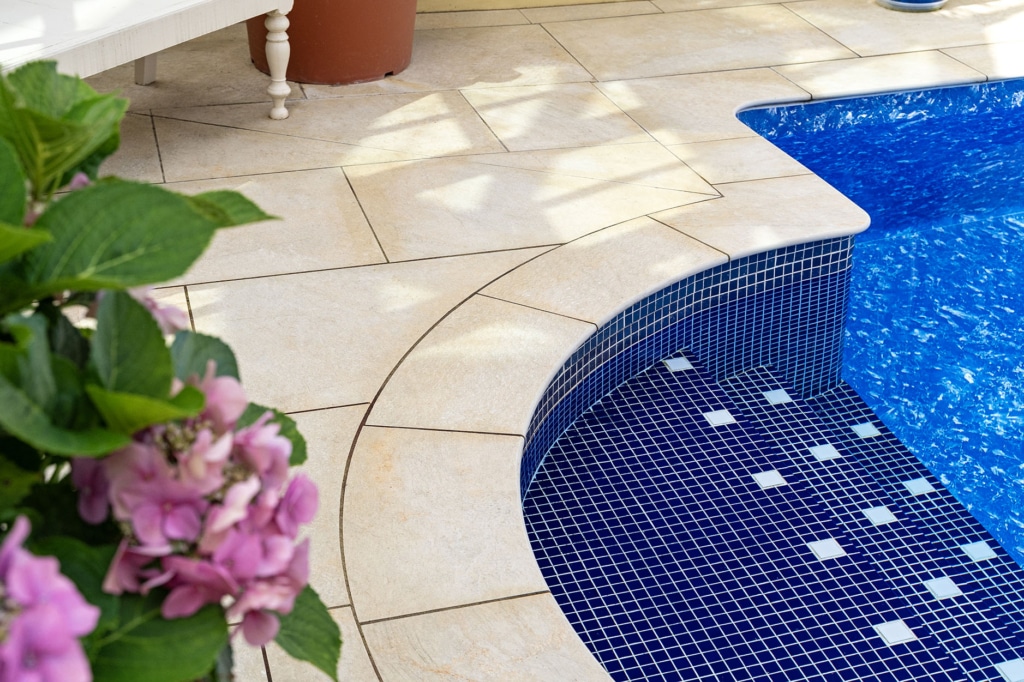

Pool Corners
Pool corners are produced in both natural stone and porcelain to match the main coping selection, and can be supplied as mitred assemblies, one‑piece radius sections or shaped units for deck‑level and overflow pools. Our range is particularly useful where pools include features such as integrated steps, benches or cover pits close to the corners. Accurate corner components reduce on‑site cutting, improve visual continuity and help avoid weak points at the most exposed parts of the pool perimeter. When you combine these units with the straight copings from the natural stone and porcelain categories, you effectively have a complete perimeter solution ready to coordinate with paving and lining tiles.

What material is best for pool copings?
The most suitable material depends on pool type, setting, maintenance expectations and how the surround will be used. Dense limestones and granites can deliver a robust, timeless finish, while porcelain copings offer very low porosity, colour stability and simplified maintenance, particularly in heavily used family or hotel pools. On many projects, the preferred approach is to match copings to the chosen pool paving material so that the surround reads as a single, coherent system.
How thick should pool coping stones be?
Most pool coping stones are supplied between about 30 mm and 50 mm thick, balancing strength, edge robustness and compatibility with adjacent paving. Some systems use tapered sections or multipiece arrangements to integrate falls and drainage, so nominal thickness can vary across the profile in order to achieve the required performance. Structural design, bearing conditions and anticipated traffic should always be confirmed with the pool builder or engineer rather than relying solely on generic figures.
Technical guidance on specifying pool copings
When specifying pool copings, the starting point is pool type, skimmer, decklevel or overflow because this determines how the coping interfaces with the shell and any channel grilles. Key variables then include material, thickness, edge profile, surface texture, module size and how copings meet corners, steps and cover pits. Digital templating and waterjet cutting enable accurate fabrication of radius sections, Roman ends and nonstandard features, reducing onsite cutting and helping maintain consistent joint lines around the pool.
Stoneworld’s pool copings are designed to work as part of a coordinated poolscape. Matching paving, steps and feature pieces can be supplied in the same stone or porcelain, with surface treatments and thicknesses chosen to balance slip performance, comfort and drainage. For refurbishments, we can work from measurements, or we can do a site visit and reproduce or update coping layouts where the shell remains in place but the surround is being upgraded.
Stoneworld Articles

Meet Stoneworld at London Build 2025 – Explore British Stone, Craftmanship and design
If you are attending, come by and visit us at Stand F20 on November 19th and 20th at Olympia London. You’ll be able to touch and test our natural stone, […]
READ MORE →
Interior design trends: porcelain & natural stone
This article compares large-format porcelain and natural stone for interiors. It covers where each works best, with guidance on formats, finishes and slip ratings (R10/R11), plus compatibility with underfloor heating. […]
READ MORE →
What are the current trends in garden design and how does stone fit in?
Modern garden design in the UK is increasingly about creating outdoor rooms that feel as usable as interiors. Spaces are planned for dining, entertaining, and relaxation, often with strong links […]
READ MORE →Pool Copings FAQ’s
-
How much do pool copings cost?

Pool copings are an investment in both the durability and beauty of your pool. At Stoneworld, we craft high-quality natural stone copings that are bespoke to your design, offering long-lasting performance and a luxurious finish. The right coping not only protects the pool edge but also elevates the overall look of your outdoor space
Read More → -
Can I match my pool copings to the surrounding paving?
Yes, Stoneworld’s pool copings are designed to coordinate with companion paving ranges in the same natural stone or porcelain, creating a seamless pool surround. You can also opt for complementary or different colours.
Read More → -
Do you supply Roman ends, corners and curved copings?
We can fabricate radius sections, Roman ends and internal or external corners using digital templating and waterjet cutting, allowing complex pool shapes to be fully resolved in stone or porcelain. If you have any ideas for your project that are not listed here, please contact our team!
Read More → -
Are pool copings slippery?
Dedicated pool copings use textured surfaces engineered for wet barefoot use, offering significantly improved grip compared with polished or indoor finishes of stone and porcelain.
Read More →


