A Stoneworld Group Company
Copings sit in the splash zone, taking the brunt of chlorine, salt and standing water. Here is how to keep natural stone and porcelain copings clean, sealed where they need it, and looking right for years.
Pool copings are the stones or tiles that border the edge of the swimming pool. Their main purpose is a practical one: they are the stone you can comfortably hold on to when you are in the water. Their second purpose is aesthetic, and just as important. Copings are often used in the design scheme to demarcate the edge of the pool, either highlighting it in a contrasting colour or blending it into the surrounding paving.

Those stones sit in the main splash zone. They take the overspill and splashing, so they need to suit the water in the pool, whether that is chlorinated, saltwater or a natural system. Keeping them clean is what makes them look good and last for years.
Different materials are used for pool copings, and the right care routine changes slightly with each:

The first thing is to maintain the stone routinely rather than waiting for a problem.
Clean debris and dirt off the stones regularly with a soft or nylon brush, or wash them down with clean water. For hardier dirt and grime, use a stone cleaner such as Rob Parker’s Best Patio Cleaner to clean deeply, then rinse thoroughly with clean water.
If your stone has a higher porosity level, and your supplier can tell you what that is, it is worth sealing it with a good quality impregnating sealer such as Rob Parker’s Best Patio Sealer. Sealing helps reduce water absorption, dirt penetration, oil and suncream staining, and general weathering.
Around a pool the type of sealer matters. Use an impregnating, breathable sealer rather than a coating. A coating or film-forming sealer can make the stone slippery, which is the last thing you want at the water’s edge.

Sealing does not make the pool maintenance free. Debris and dirt on the surface of the stone still need to be cleaned away as part of a regular routine.
Prevent standing water on the copings and on any natural stone paving around them. Correct falls and drainage let water flow away instead of gathering in puddles, drying out and leaving mineral deposits and staining behind.
If chlorine or salt residues dry onto the stone, Rob Parker’s Best salt neutraliser will remove those deposits safely.
You also do not want natural stone sitting wet or saturated for long, because that is when algae takes hold and the surface turns slippery. If algae does appear in shady pockets, Rob Parker’s Best Algae Remover and Patio Reviver will clear it and keep it at bay for up to 12 months. Stone that sits wet also lets lichens attach more easily. That is not the end of the world, as Patio Cleaner will shift lichens and black spot, but prevention is easier: a regular routine stops them taking a firm hold.
All of the above applies equally to any natural stone paving surrounding the pool.
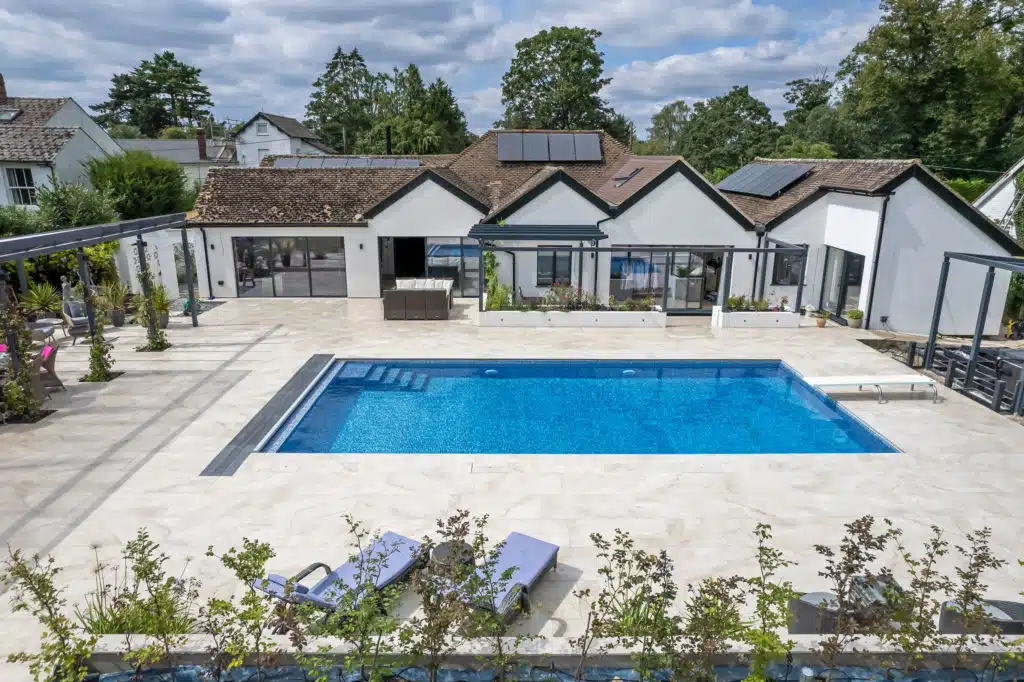
Porcelain is a man-made material. Where natural stone has pores that make it absorbent, porcelain has none, so it is non-absorbent. That makes it easier to keep stain free, but it does not make it maintenance free.
A regular cleaning routine is still advised, exactly as with natural stone. Remove debris and dirt from the surface with a brush and clean water, and reach for a patio cleaner for more stubborn grime. Minerals leaching out of wet leaves, or bird mess, will still stick to the surface even though they have not sunk into the tile, and that is where a cleaner earns its place.
Correct falls and drainage matter here too, for the same reasons. Porcelain does not need sealing: with no pores in the material, a sealant has nothing to soak into.
These are the Rob Parker’s Best products referred to above, all suitable for use around a pool:


If you are unsure which product suits your stone, or you have a mark that will not shift, send us a photograph and we will tell you what we would use on it.
 sales@stoneworld.co.uk
 01844 279274