A Stoneworld Group Company
Understanding the London market, Scoutmoor, Appleton and Forest Pennant
Forest Pennant is a well-established British sandstone with a strong reputation for commercial paving, particularly across the South West and increasingly in London.
But there is an important question worth asking:
The answer is not simply that Forest Pennant is a better or more technically capable stone.
A significant part of the story is what happened to Scoutmoor Yorkstone, one of the most recognisable British sandstone paving products used in the London market.

For many years, Scoutmoor was marketed by Marshalls as a premium blue-grey to brown Yorkstone for commercial and public-realm paving.
It was particularly well suited to the London market because of its colour, appearance, strength, durability and slip resistance.
Marshalls’ own technical information described Scoutmoor as a blue-grey to brown, fine-grained Yorkstone, suitable for pedestrian and trafficked areas, with applications including paving, setts, kerbs, tactile paving and steps.
However, the original Scoutmoor quarry in Lancashire ceased to be the source of the product.
Marshalls subsequently discontinued the Scoutmoor product. Its current website now states that Scoutmoor is being discontinued.
This created a significant gap in the market.
Architects, landscape architects, contractors and developers who had specified Scoutmoor still wanted a similar grey/brown, fine-grained British sandstone.
And that is where Forest Pennant became particularly relevant.

Forest Pennant has a naturally grey-blue to brown colour range and is a hard-wearing British sandstone.
The mixed Forest Pennant product in particular can provide a visual appearance that sits within a similar design territory to the Scoutmoor that many London specifiers had become accustomed to.
Forest of Dean Stone Firms’ current technical data describes its mixed Pennant as having:
There is nothing wrong with those figures.
Forest Pennant is a capable, hard-wearing paving stone and has been used extensively in commercial and public-realm projects.
The question is therefore not:
It is.
The more interesting question is:

According to Stoneworld’s experience of the London market following the withdrawal of Scoutmoor, Forest Pennant prices increased significantly, with Stoneworld recording an increase of approximately 50%.
At the time, this left specifiers with relatively few realistic British alternatives if they wanted the same general grey/brown aesthetic.
That matters because pricing is influenced by more than the intrinsic performance of the stone.
When a product disappears from a market, the remaining products capable of filling that gap can command a premium.
In other words:
Forest Pennant was already established, visually relevant and available.
For projects that had previously specified Scoutmoor, there were suddenly fewer alternatives.

This is where the story gets interesting.
Stoneworld has now secured Appleton Yorkstone block and is having it processed into paving specifically for the London market.
Appleton is not a new or untested stone.
It is an established Yorkshire sandstone from the Appleton Quarry in West Yorkshire.
Marshalls describes Appleton as a blue/buff Yorkstone with excellent durability and hard-wearing characteristics, suitable for paving, kerbs, tactile applications and bespoke masonry.
A BRE technical assessment of Appleton describes it as a fine-grained Carboniferous sandstone ranging from fawn through to darker mottled brown, and concludes that the stone appears durable, with good resistance to acid rain and air pollution.
And there is an important connection to Scoutmoor.
Marshalls’ own March 2025 Scoutmoor technical datasheet identified:
So whilst the original Scoutmoor quarry had ceased to be available, the Scoutmoor product being marketed by Marshalls in 2025 was already being produced from an Appleton/Whitworth quarry source combination.
That makes the availability of Appleton particularly significant for anyone who wants the appearance and performance associated with the later Scoutmoor specification.
The technical comparison is particularly useful.
The comparison does not show a situation where Forest Pennant dramatically outperforms Appleton.
In fact, the two stones are broadly comparable as commercial paving materials, with each having different strengths.
Forest Pennant has lower water absorption and stronger published wet slip figures.
Appleton has higher published compressive strength and very similar flexural and abrasion performance.
So the argument should not be:
The more defensible argument is:
This is perhaps the most important point for architects and landscape designers.
Forest Pennant is generally characterised by its grey and blue-grey base tones with brown, buff and natural geological variation.
Appleton has a blue/grey to brown/buff appearance, with natural colour variation and markings. Marshalls describes it as light blue-grey to brown and as a fine-grained sandstone.
This means Appleton occupies a very similar visual territory to the type of British grey/brown sandstone that made Scoutmoor so popular.
It is not an imported imitation.
It is not a concrete substitute.
It is not a manufactured product designed to look like Yorkstone.
There are several factors.
The withdrawal of Scoutmoor removed one of the principal products serving this particular aesthetic and specification requirement.
Architects, landscape architects and contractors had become accustomed to the blue-grey/brown appearance associated with Scoutmoor.
Forest Pennant offered an established British sandstone with a similar visual character and strong commercial performance.
With fewer obvious alternatives available, the market had less price competition.
Stoneworld is now bringing Appleton sandstone paving back into this part of the market.
That changes the equation.

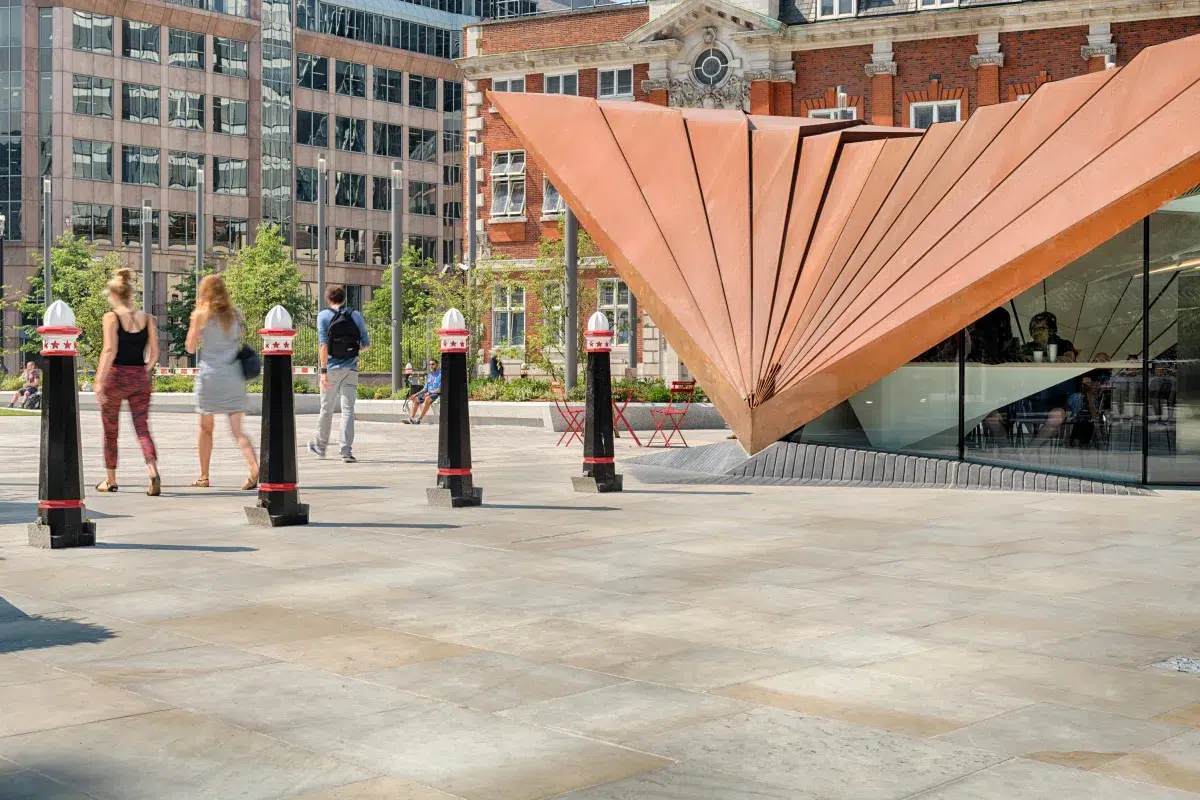
Stoneworld has secured Appleton block and is having it processed specifically for paving applications.
This means that architects, landscape architects, contractors and developers specifying a grey/brown British sandstone no longer have to automatically default to Forest Pennant simply because Scoutmoor is no longer readily available.
And importantly, it is not a new stone trying to establish a reputation.
Appleton has a long history of use in architectural and landscape applications.
Marshalls’ own quarry information describes Appleton as having extensive reserves and being suitable for walling, paving and bespoke masonry.
Appleton has also been used on significant international architectural projects, including the de Young Museum in San Francisco.
The key message is simple.
Stoneworld’s Appleton Yorkstone paving provides:
Most importantly, it provides competition in a market where competition became limited following the withdrawal of Scoutmoor.
Forest Pennant is a good British sandstone.
But good does not automatically mean it needs to command a premium simply because the market lost Scoutmoor.
The arrival of Stoneworld Appleton changes the options available to the London market.
If your project was originally looking at Scoutmoor, or you are currently considering Forest Pennant because you believe there is no alternative, speak to Stoneworld before committing to the specification.
We can discuss the project, compare the stones and provide Appleton paving for consideration.
 sales@stoneworld.co.uk
 01844 279274